Step 1
Start the Conversation
Tell us about your concerns, goals and what you're hoping to achieve.
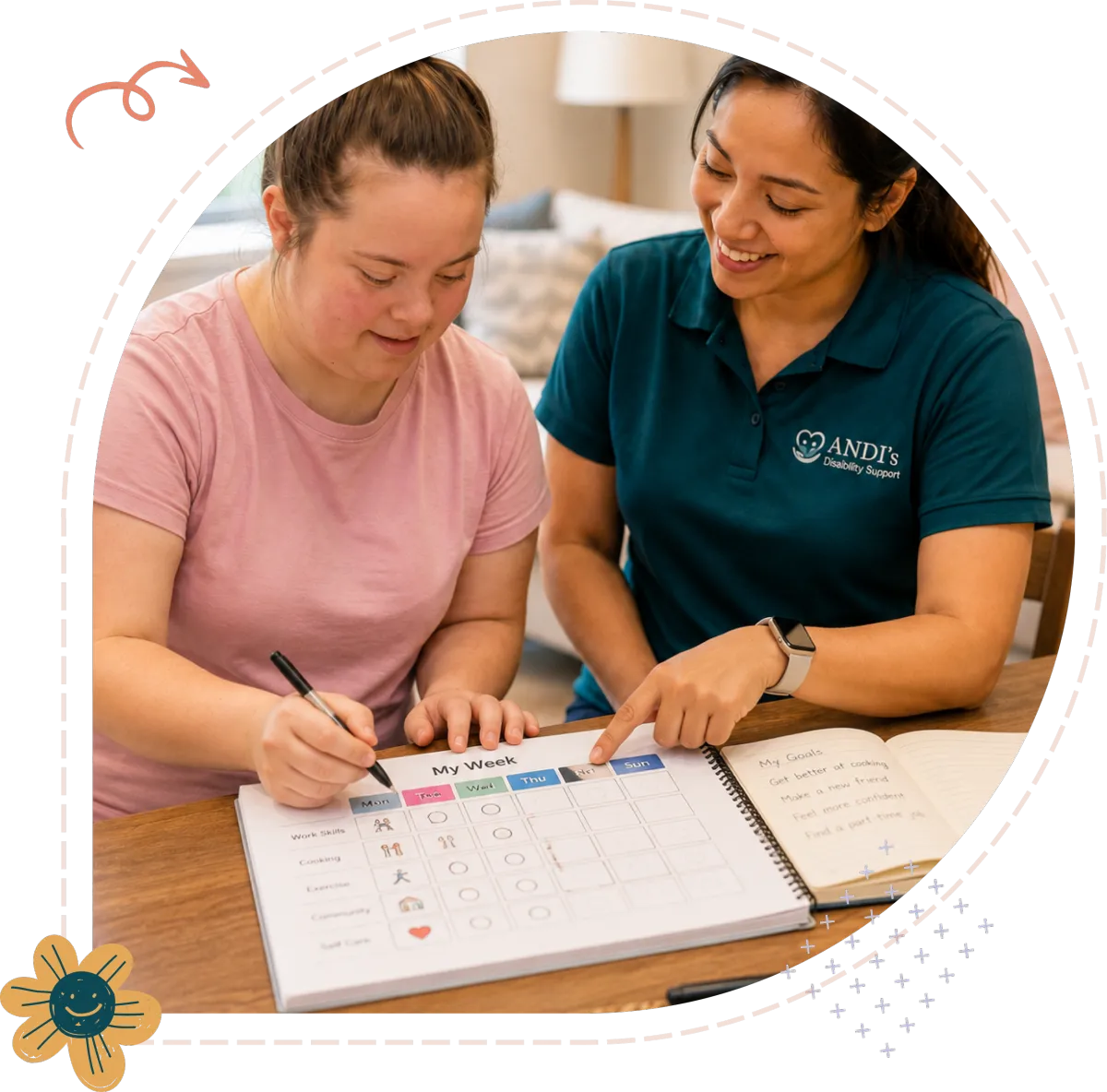
ANDI works with children, teenagers, adults and older Australians, and with the families and carers around them. What changes between those stages is not whether we can help, but what helping looks like.
Not sure which stage fits, or whether we are the right service at all? Ask us. A short conversation usually settles it faster than reading the whole page.

The stages on this page are a way of finding the right starting point quickly. They are not eligibility rules, and nobody gets turned away for being between two of them.
A four year old who is not talking yet, a ten year old who cannot get through a school day without melting down, a fifteen year old who has stopped going in, a twenty two year old learning to live out of home, a forty year old who has wondered about themselves since school, an eighty year old who wants to stay in their own house. Those are all people we see, and they need very different things.
What stays the same is the order of the work. We listen first, we work out what is actually going on, and then we recommend the smallest useful thing rather than the largest billable one. Sometimes that is a single conversation with a school. Sometimes it is years of coordinated support.
Age also affects how support gets paid for, more than it affects what we can offer. The NDIS, Medicare, private health and Home Care Packages each have their own rules about who qualifies and when, which is covered further down.

Speech, play, motor skills and the routines that make kinder and childcare easier.

Communication, learning, sensory processing and the practical skills school asks for.

Counselling, emotional support, and the transitions that come thick and fast.

Life skills, confidence, and preparing for work, study or moving out.

Assessment, therapy, counselling and disability support, built around goals you set.

Home care, therapy and practical help, so staying put stays realistic.
Tell us about your concerns, goals and what you're hoping to achieve.
We take the time to understand your situation and recommend the services that best support your individual.
Together, we develop a coordinated plan tailored to your strengths, goals and circumstances.
As your needs evolve, your support evolves too. Our team continues working alongside you to promote meaningful progress and long-term success.
Age changes the funding more than it changes the service. These are the pathways that come up most,
and which one applies depends on the person, the service and the year they were born.

For people with permanent and significant disability who applied before turning 65. Covers a lot of what we do for children and working-age adults, but not everything.

The usual pathway from 65, and from 50 for Aboriginal and Torres Strait Islander people. Starts with an assessment through My Aged Care.

Rebates for eligible services with a GP referral and care plan, at any age. A rebate covers part of the fee rather than all of it.
No eligibility decision to wait on. Extras cover depends on your level of cover and your remaining limit, which your fund can confirm before you book.
Our team is happy to talk it through before you book anything.
No. We work with people from infancy through to older age. What does change with age is funding rather than eligibility: NDIS access is for people who apply before turning 65, and aged care funding generally starts at 65. We will tell you which pathway applies to your situation when you contact us.
No, and you do not need a referral either. Plenty of people come to us with nothing more than a worry they cannot name. If it turns out an assessment would help answer it, we can do that; if it turns out the answer is something simpler, we will tell you that instead.
Yes, and it is common. Needs change at every transition, and finishing a block of therapy is not meant to be permanent. Their history stays with us, so returning is a conversation rather than a full new intake.
Yes. Siblings, parents and carers are often seen alongside the person who was referred first. Where it matters clinically, each person has their own clinician and their own confidentiality, and we will be clear about what is shared between them before anything starts.
No. The NDIS is one of several ways people pay for support at ANDI, alongside private payment, Medicare rebates where a service is eligible, private health extras and Home Care Packages. A large share of the people we see have no NDIS plan at all.
Whether you're seeking support for yourself, your child or a loved one, we're here to listen, understand and help you move forward with confidence.
From assessment and therapy to counselling, disability support and home care, our team is committed to providing personalised care that empowers individuals and strengthens families.

We care deeply about the people we support, and it shows in how we work.

Qualified clinicians who supervise each other and keep learning.

Support that stays with you as your needs change, not just at the start.



We honour the diverse communities such as the LGBTQ of which we are a part and we celebrate the extraordinary diversity of people that each represent.

We acknowledge the traditional owners of the lands. We pay respect to Elders, past and present and acknowledge the ongoing connection that Aboriginal people have to this land and recognise Aboriginal people as the original custodians of this land.

Aboriginal peoples of the Kulin Nations are the Traditional Custodians of the lands now named City of Greater Dandenong. Those who live, work and contribute to the municipality walk in the footsteps of the Bunurong/Boon Wurrung and Wurundjeri Woi-wurrung Peoples, and are enriched by Australia’s First Peoples experiences, cultures, histories and knowledge.
© 2026 ANDI Support. All rights reserved.