Step 1
Start the Conversation
Tell us about your concerns, goals and what you're hoping to achieve.
People come to a cognitive assessment for one of two reasons: something has changed and they want to know what, or a decision needs evidence behind it and an impression will not do.
If a doctor has raised a concern about memory or thinking, start with them. A cognitive assessment supports that process; it does not replace the medical part of it.

The two overlap and are often confused. An IQ assessment estimates general ability. A cognitive assessment maps a wider set of thinking skills and is usually asking a different question: what is working, what is not, and compared with what.
That comparison is the point. Sometimes it is against people of the same age. Sometimes it is against the person's own previous level, which is what matters when something has changed after an illness, an injury or a health event. A result that looks average can still represent a significant decline for that individual.
The output is a profile rather than a verdict: attention, memory, speed, language, organisation and spatial skills, each described in terms of what it means for school, work or daily life, with recommendations that follow from it.
It is a description of how someone thinks. It is not, on its own, a medical diagnosis, and we are careful about the difference.
Six areas, tested separately, because thinking is not one skill and difficulties are almost never spread evenly across it.

Holding focus, dividing it, and getting it back after an interruption. Weakness here drags down performance in every other area.
Looks like
Losing the thread part-way through a task
Managing one thing but not two at once
Errors that appear only when tired or rushed
Needing everything quiet to work at all
Taking new information in, holding it, and getting it back out again. Those are three separable skills and they fail in different ways.
Looks like
Forgetting conversations, appointments or instructions
Recognising something when prompted but not recalling it cold
Needing many more repetitions than before
Relying heavily on notes, lists and reminders
How quickly familiar information is handled accurately. Slower speed is tiring long before it is obvious to anyone else.
Looks like
Taking much longer over routine work
Struggling with anything timed
Fatigue disproportionate to the effort involved
Falling behind in conversation or in meetings
Finding words, understanding what is said, and following something complicated at the speed it is delivered.
Looks like
Word-finding difficulty, or talking around a word
Losing the sense of long or complex sentences
Reading the words but not retaining the meaning
Difficulty following a group conversation
Planning, starting, sequencing, switching and monitoring. The management layer, and often the one that causes most disruption day to day.
Looks like
Knowing what to do and being unable to start
Difficulty planning several steps ahead
Getting stuck on one approach that is not working
Decisions that used to be straightforward becoming hard
Judging space, direction and layout, and working with what is seen rather than what is said.
Creativity, judgement, character or persistence
Social understanding and emotional skill
Practical, everyday and adaptive skills
What a person will go on to achieve

Speech, play, motor skills and the routines that make kinder and childcare easier.

Communication, learning, sensory processing and the practical skills school asks for.

Counselling, emotional support, and the transitions that come thick and fast.

Life skills, confidence, and preparing for work, study or moving out.
Assessment, therapy, counselling and disability support, built around goals you set.
Home care, therapy and practical help, so staying put stays realistic.
Standardised testing is only meaningful when the conditions are standard. That constrains how it is administered, and it constrains what the result can be taken to mean.

One-to-one with a clinician, working through a series of tasks that get progressively harder. Most people find it more interesting than they expected.
History first, including what has changed, when, and what the person was like before, which is what any comparison depends on.
Tests selected for the question, not a fixed battery run regardless of why you came.
Everyday factors accounted for: sleep, pain, medication, mood, hearing and vision all move results and all get asked about.
Findings described functionally, in terms of what they mean for work, school, driving or living independently.

Some cognitive questions need a clinical neuropsychologist or a medical specialist. We would rather tell you that at the enquiry than take the booking.
We do not diagnose dementia. That is a medical diagnosis, made by a doctor, usually with investigations we do not perform.
Suspected brain injury, stroke or neurological illness generally needs comprehensive neuropsychological assessment.
We do not do medico-legal or capacity determinations, which are a specialist field with their own requirements.
Where the right answer is someone else, we will say so and help you work out who, rather than doing an assessment that will not answer it.
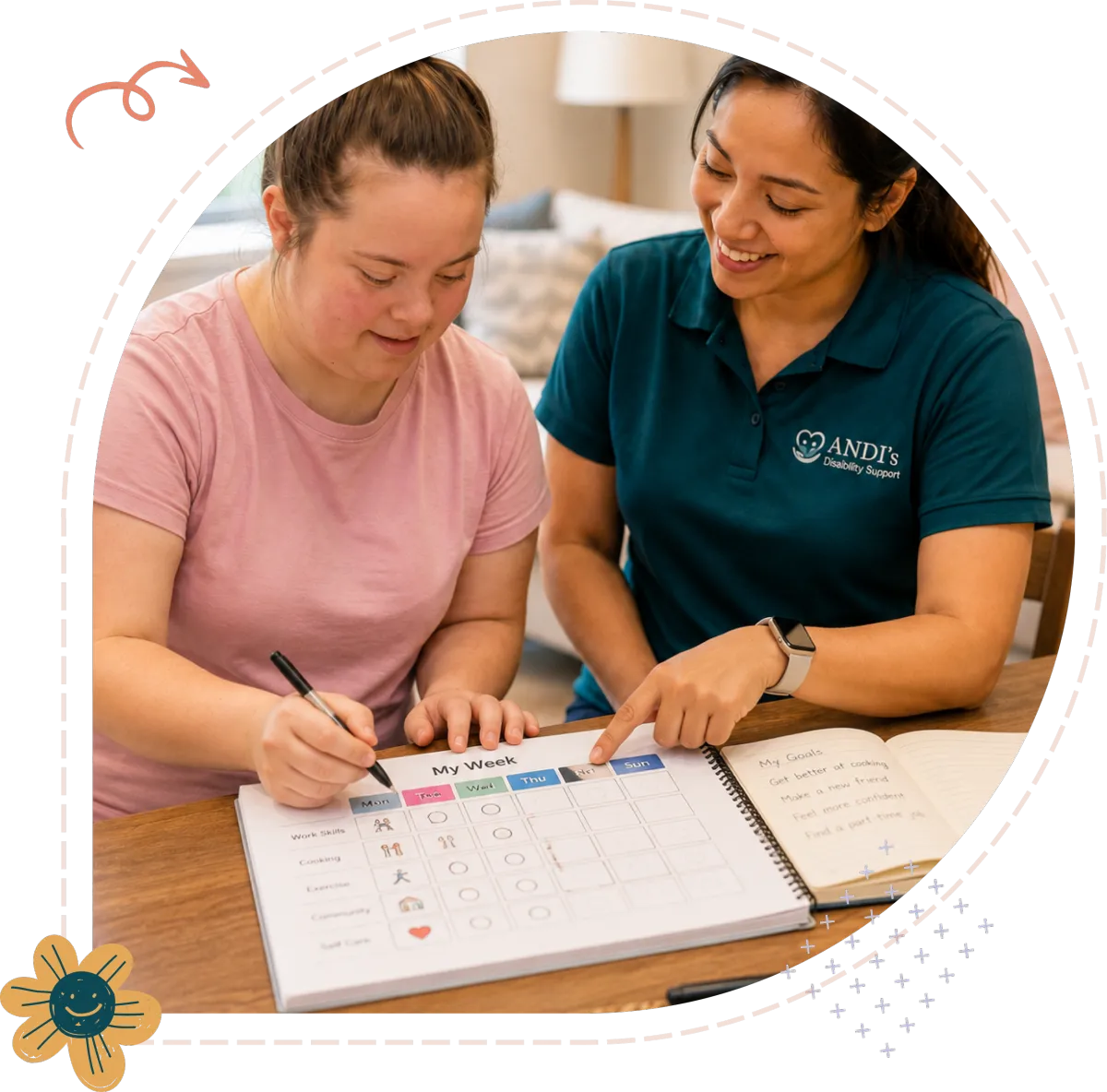
Tell us about your concerns, goals and what you're hoping to achieve.
We take the time to understand your situation and recommend the services that best support your individual.
Together, we develop a coordinated plan tailored to your strengths, goals and circumstances.
As your needs evolve, your support evolves too. Our team continues working alongside you to promote meaningful progress and long-term success.
Cost depends on how broad the assessment needs to be, which depends on the question. A focused assessment for study adjustments is a smaller piece of work than a full profile.
We quote the whole cost in writing before you commit, report included. If the assessment you need is one we should not be doing, we will tell you at the enquiry rather than after you have paid.
No referral and no eligibility decision to wait on. The full cost is quoted before the first appointment.
Cognitive assessment is funded in some plans, usually where it supports a stated goal or a plan review. We will check what your plan allows.
Rebates are available for eligible services with a GP referral and care plan. A rebate covers part of the cost rather than all of it.
For older adults, assessment can sometimes be drawn from a package. Private health extras may also apply, depending on your cover.
Cognitive assessment overlaps with several others, and the right one depends entirely on the question. If one of these is closer, tell us.
Communication, social interaction, sensory experience and developmental history, gathered across settings.
Attention, activity, impulsivity and executive functioning, with information from home and from school or work.

A standardised measure of cognitive ability across four areas of reasoning, memory and speed.
Our team is happy to talk it through before you book anything.
An IQ assessment estimates general ability and reports an overall score alongside a profile. A cognitive assessment covers a wider set of thinking skills, including memory and executive function, and is usually asking about a specific difficulty or a change rather than about general ability.
There is real overlap, and cognitive testing forms part of several other assessments. Tell us the question and we will tell you which one answers it.
No. Dementia is a medical diagnosis, made by a doctor, usually alongside examination, blood tests and sometimes imaging, none of which we perform.
If memory or thinking has changed, start with your GP. Where comprehensive neuropsychological assessment is needed, that is a clinical neuropsychologist's work and we will say so rather than take the booking.
Yes, frequently, which is why we ask about all of it before testing. Poor sleep, pain, depression, anxiety, thyroid problems, some medications, alcohol, hearing loss and simply being unwell on the day all lower cognitive test performance.
Several of those are treatable. Identifying one is a genuinely good outcome, and the report will say plainly where results may have been affected.
It can, because those processes generally want function described rather than a diagnosis quoted. A cognitive profile that explains what a person can do, under what conditions, and with what support, is the kind of evidence they work from.
We cannot guarantee an outcome, since those decisions are made by the agency or the employer. Tell us at intake who the report is for and we will make sure it covers what that process asks for.
No preparation, and no practice. Bring your glasses and hearing aids if you use them, a list of current medications, and any previous assessment reports.
Come reasonably rested if you can, and tell us if you are having an unusually bad day. We would rather reschedule than test someone at their worst and report the result as though it were typical.
Whether you're seeking support for yourself, your child or a loved one, we're here to listen, understand and help you move forward with confidence.
From assessment and therapy to counselling, disability support and home care, our team is committed to providing personalised care that empowers individuals and strengthens families.
We care deeply about the people we support, and it shows in how we work.

Qualified clinicians who supervise each other and keep learning.

Support that stays with you as your needs change, not just at the start.



We honour the diverse communities such as the LGBTQ of which we are a part and we celebrate the extraordinary diversity of people that each represent.

We acknowledge the traditional owners of the lands. We pay respect to Elders, past and present and acknowledge the ongoing connection that Aboriginal people have to this land and recognise Aboriginal people as the original custodians of this land.
Aboriginal peoples of the Kulin Nations are the Traditional Custodians of the lands now named City of Greater Dandenong. Those who live, work and contribute to the municipality walk in the footsteps of the Bunurong/Boon Wurrung and Wurundjeri Woi-wurrung Peoples, and are enriched by Australia’s First Peoples experiences, cultures, histories and knowledge.
© 2026 ANDI Support. All rights reserved.