Step 1
Start the Conversation
Tell us about your concerns, goals and what you're hoping to achieve.
The goal is not a quieter, tidier, more typical person at the end of it. The goal is a week that works — mornings, school, work, friendships, sleep — for the brain someone already has.
A diagnosis is not a condition of getting support here. If having one would open doors for you we can talk about assessment, and if it would not, we can start without it.

Neurodivergent is a broad word. It covers autistic people, people with ADHD, and people whose learning, sensory processing or thinking works differently from what the room was designed for. What those experiences have in common is not a set of symptoms. It is the daily cost of operating in settings built for somebody else.
So the work here is rarely about fixing a deficit. It is about lowering that cost. That might mean a morning routine that survives a bad night's sleep, a way of starting tasks that does not depend on feeling like it, headphones in a classroom, a manager who understands why the open-plan desk is the problem, or language for explaining yourself to people who keep getting you wrong.
We are neurodiversity-affirming, which is a phrase used loosely enough that it is worth saying what we mean by it. We do not run programs that teach a person to hide how they think in order to be easier for other people. We treat distress, exhaustion and being stuck as things worth working on, and we treat difference as something to work with.
Support is drawn from across the team — occupational therapy, speech pathology, counselling, and support workers where practical help is what is needed. Which of those you see depends on what is hard, not on which door you came through.
Six areas that come up again and again. Almost nobody arrives wanting all six - most people have one that is making the others harder.

Big feelings that arrive faster than the words for them, and the long flat recovery afterwards. Usually the thing families ring about first.
Often includes
Meltdowns, shutdowns and what comes before them
Recognising the early signs, in yourself or your child
Anxiety, frustration and rejection sensitivity
Recovery time, and building a week that allows for it
Starting, switching, planning and finishing. The gap between knowing exactly what needs doing and being able to begin it.
Often includes
Getting started on things that matter
Time, deadlines and how long things actually take
Organisation, memory and the systems that survive a bad week
Study, assignments and managing a workload
The parts of the day that keep going wrong at the same time every day. Mornings, transitions, meals, bedtime, and the slow build towards doing things alone.
Often includes
Morning and bedtime routines that hold
Transitions between activities, places and people
Self-care, cooking, money and getting around
Moving out, working, and running your own household
Being understood, and finding people worth being understood by. Support on your own terms, not coaching to look neurotypical.
Often includes
Conversation, friendships and repairing them when they go wrong
Saying no, asking for help and self-advocacy
Communication support, including for people who speak little or not at all
Explaining your needs to a school, a workplace or a partner
Noise, light, texture, clothing, crowds and the body's own signals. Sensory load explains an enormous amount of behaviour that gets read as something else.
Often includes
Working out the pattern rather than guessing at it
Classrooms, supermarkets, offices and public transport
Eating, clothing and personal care
Adjusting the environment first, and the person second
The people alongside a neurodivergent person are doing a job nobody trained them for, often while being told the problem is their parenting.
Often includes
Understanding what is actually happening, and what is not
Responses that work in the moment rather than in theory
Talking to schools, services and relatives
Your own load, and what to do about it

Speech, play, motor skills and the routines that make kinder and childcare easier.

Communication, learning, sensory processing and the practical skills school asks for.

Counselling, emotional support, and the transitions that come thick and fast.

Life skills, confidence, and preparing for work, study or moving out.

Assessment, therapy, counselling and disability support, built around goals you set.

Home care, therapy and practical help, so staying put stays realistic.
Two principles do most of the work here: look at the week rather than the person, and change the environment before you ask anybody to try harder.

Two autistic people can need opposite things. So the first job is finding out where the week actually breaks — which hour, which room, which transition — because that is far more useful than a label for planning what to do next.
A conversation about the day, hour by hour if that helps. What is fine, what is expensive, and what everyone has quietly given up on.
Strengths taken seriously, including interests. They are usually the most reliable tool available and the first thing other services take away.
Goals in the person's own words, or the family's. Not a standard program with your name typed at the top.
An honest scope. If what you need is a diagnosis, a paediatrician or a different service, we will tell you that at the start rather than after ten sessions.

A great deal of what looks like an individual difficulty is a mismatch with a room, a routine or an expectation. Adjusting those is often faster, cheaper and more durable than teaching somebody to tolerate them.
Practical accommodations for home, the classroom and the workplace, written down in language the other people involved will actually use.
Work with schools and employers, with consent, so the strategies do not stop at our door and get contradicted at nine the next morning.
Skills where skills are the gap, taught explicitly rather than expected to appear — but never as a substitute for a reasonable adjustment.
Review at the end of a block. If it is not working we change the approach rather than book more of the same.
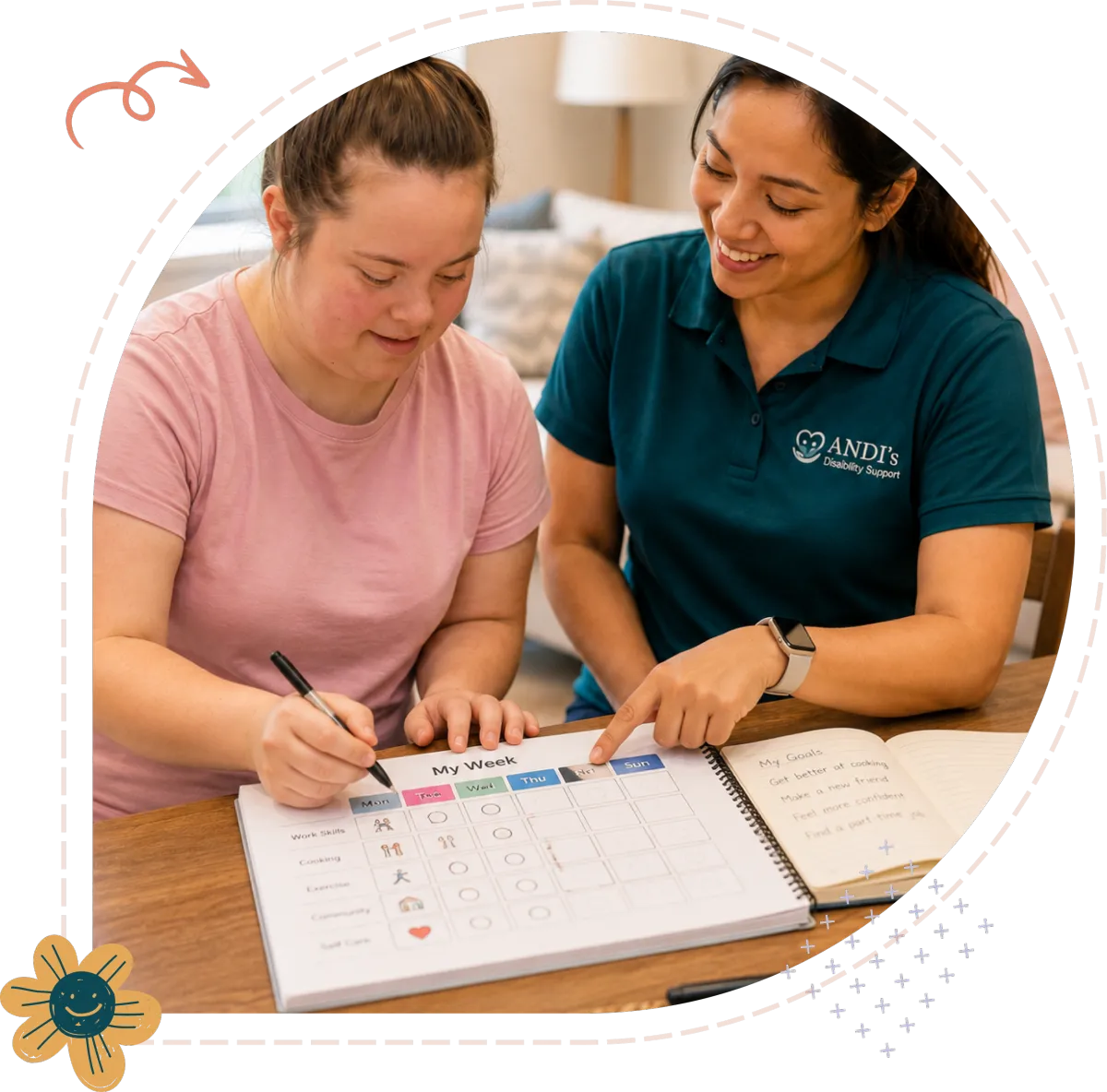
Tell us about your concerns, goals and what you're hoping to achieve.
We take the time to understand your situation and recommend the services that best support your individual.
Together, we develop a coordinated plan tailored to your strengths, goals and circumstances.
As your needs evolve, your support evolves too. Our team continues working alongside you to promote meaningful progress and long-term success.
Neurodiversity support is not a single funded item. It is therapy, counselling and practical support billed as those things, so the pathway depends on who you are rather than on the label above this section.
We do not publish one price, because the honest answer is a written quote for what you actually need. Ask us early — sorting out the funding question before the first appointment saves a great deal of frustration later.
No eligibility test and no waiting on a decision. The fee for each appointment type is quoted before you book.
Where someone has a plan, therapy and support that meet their plan goals can usually be funded. Being neurodivergent does not by itself mean having a plan.
Rebates apply to eligible services with a GP referral and care plan. They cover part of the fee, and not every appointment on this page qualifies.
Depends on your cover and your remaining limit. Your fund can confirm the rebate for each service before you book.
Our team is happy to talk it through before you book anything.
No. Support here is organised around what is difficult, not around a diagnostic code, so we can start with the difficulty in front of us.
A diagnosis does matter for some things — certain funding, some school and workplace adjustments, and for many people the simple relief of an explanation. If any of those apply to you, we can talk about assessment as a separate decision rather than a prerequisite.
Mostly it is therapy, with a particular lens. The clinicians are occupational therapists, speech pathologists and counsellors, and what makes it neurodiversity support is the goal we are working towards rather than a separate technique.
The practical difference is where we look first. A generic program asks what the person cannot do. We ask what the day is demanding and whether that demand is reasonable, and quite often the useful change is somewhere other than the person.
Not in the traditional form, where autistic children are taught to perform neurotypical conversation and are scored on eye contact. The evidence that this improves anyone's life is thin, and there is reasonable evidence it teaches masking, which carries its own cost.
What we do support is genuine connection: understanding your own communication style, finding people you can be yourself around, handling conflict, and having the adults involved adjust their side of the exchange too.
Yes, and it is a growing part of what we do. Late-identified adults often arrive after burnout, a job that stopped being manageable, or a child's assessment that explained rather a lot about themselves.
The work tends to be practical and unsentimental: workload, sleep, sensory environment, executive functioning, what to disclose at work, and undoing thirty years of assuming you were simply bad at things everyone else found easy.
Yes, with your consent and where the school is willing. That can be a written set of adjustments, a phone call, a meeting, or a visit to see what the classroom is actually like at the time of day things fall apart.
We will be honest about the limits. We can recommend adjustments; we cannot compel a school to make them. Where a school will not move, we will tell you plainly and help you decide what to do with that.
Whether you're seeking support for yourself, your child or a loved one, we're here to listen, understand and help you move forward with confidence.
From assessment and therapy to counselling, disability support and home care, our team is committed to providing personalised care that empowers individuals and strengthens families.

We care deeply about the people we support, and it shows in how we work.

Qualified clinicians who supervise each other and keep learning.

Support that stays with you as your needs change, not just at the start.



We honour the diverse communities such as the LGBTQ of which we are a part and we celebrate the extraordinary diversity of people that each represent.

We acknowledge the traditional owners of the lands. We pay respect to Elders, past and present and acknowledge the ongoing connection that Aboriginal people have to this land and recognise Aboriginal people as the original custodians of this land.

Aboriginal peoples of the Kulin Nations are the Traditional Custodians of the lands now named City of Greater Dandenong. Those who live, work and contribute to the municipality walk in the footsteps of the Bunurong/Boon Wurrung and Wurundjeri Woi-wurrung Peoples, and are enriched by Australia’s First Peoples experiences, cultures, histories and knowledge.
© 2026 ANDI Support. All rights reserved.