Step 1
Start the Conversation
Tell us about your concerns, goals and what you're hoping to achieve.
Small children do not learn in appointments. They learn at breakfast, in the bath, on the way to the car and on the mat at kinder. Early intervention works by changing what happens in those moments, which is why so much of it is aimed at you rather than at your child.
No diagnosis and no referral needed. A concern you cannot quite put your finger on is a good enough reason to call, and being told your child is doing fine is a real answer, not a wasted appointment.

Families often expect a program done to their child in a room. What the evidence supports is closer to the opposite: a clinician who shows you what to do differently in the ordinary moments of the day, then helps you get good at it.
There is a straightforward reason for that arithmetic. A weekly session is one hour. You have the other hundred and sixty-seven, and so do the educators at childcare. Skills practised in twenty small moments across a week stick in a way that an hour on a mat with a stranger does not.
So we work in your routines. Nappy changes, the car seat, snack time, the walk to the park, the ten minutes before dinner when everyone is tired. We watch what is already happening, change one or two things, and come back to see whether it worked.
What we will not do is turn your home into a clinic or hand you a program that assumes your afternoon is empty. If a strategy does not survive contact with a real week, it is the wrong strategy and it is our job to find a better one.
Six areas, though families rarely arrive with one. Early development is tangled: sleep affects behaviour, behaviour affects play, play is where language is built.

The most common reason families call us. Not talking yet, hard to understand, or understanding far more than they can say.
Often includes
Late talking and few or no words
Speech that others cannot understand
Following simple instructions
Gestures, signs and other ways to communicate while speech develops
Play is a small child's whole curriculum. When it is limited or repetitive, a lot of other learning has nowhere to happen.
Often includes
Play skills, imagination and playing alongside other children
Crawling, walking, climbing and coordination
Hands: grasping, stacking, drawing, using a spoon
Sensory responses that make everyday activities hard
Behaviour in small children is communication before it is anything else. Usually the useful question is what it is telling us.
Often includes
Big reactions, and how long they last
Separation, clinginess and settling at childcare
Playing with other children and starting to share
Attachment, connection and the parent–child relationship
The unglamorous parts of family life that decide whether a week is manageable. Fixing one of these often improves three other things.
Often includes
Fussy eating and mealtimes that have become a battle
Sleep routines and settling
Dressing, toileting and washing
Transitions, leaving the house and getting in the car
Where development is following a different path, support is about participation and quality of life rather than catching up to a chart.
Often includes
Developmental delay, including global delay
Early signs of autism, and support for autistic toddlers
Attention and activity levels that stand out from other children
Physical and medical conditions affecting development
The engine of the whole thing. Not a lecture on child development — specific, practical changes to what you already do.
Often includes
Ways of talking and playing that grow language
Responding to behaviour without a fight every time
Strategies shared with childcare and kinder, with your consent
Support for you: this is tiring, and pretending otherwise helps nobody

Speech, play, motor skills and the routines that make kinder and childcare easier.

Communication, learning, sensory processing and the practical skills school asks for.

Counselling, emotional support, and the transitions that come thick and fast.

Life skills, confidence, and preparing for work, study or moving out.

Assessment, therapy, counselling and disability support, built around goals you set.

Home care, therapy and practical help, so staying put stays realistic.
Two things distinguish a good early years service from a busy one: the work happens in real routines, and one person holds the whole picture.

We would rather watch a real snack time than run a tidy activity that never happens again. Sessions are built out of what your family already does, because that is what will still be there next Tuesday.
We watch first. What is already working is the most useful information in the room, and there is always something.
You try it while we are there, rather than being told about it and left to guess. Coaching means practising with someone watching.
One or two changes at a time. A list of fifteen strategies is a list nobody uses.
Siblings, grandparents and educators welcome. Everyone who does the routine should know the plan.

A small child can end up with a speech pathologist, an occupational therapist, a paediatrician and a kinder all working on their own version of the same problem. That is exhausting and it is not more support.
One main contact who knows your family, even when more than one discipline is involved.
Goals your family chose, written in ordinary words: "can tell us what he wants at dinner", not a set of scores.
Clinicians who talk to each other without you having to carry the message between them.
Blocks with an end date and a review, so support finishes when it should rather than continuing out of habit.
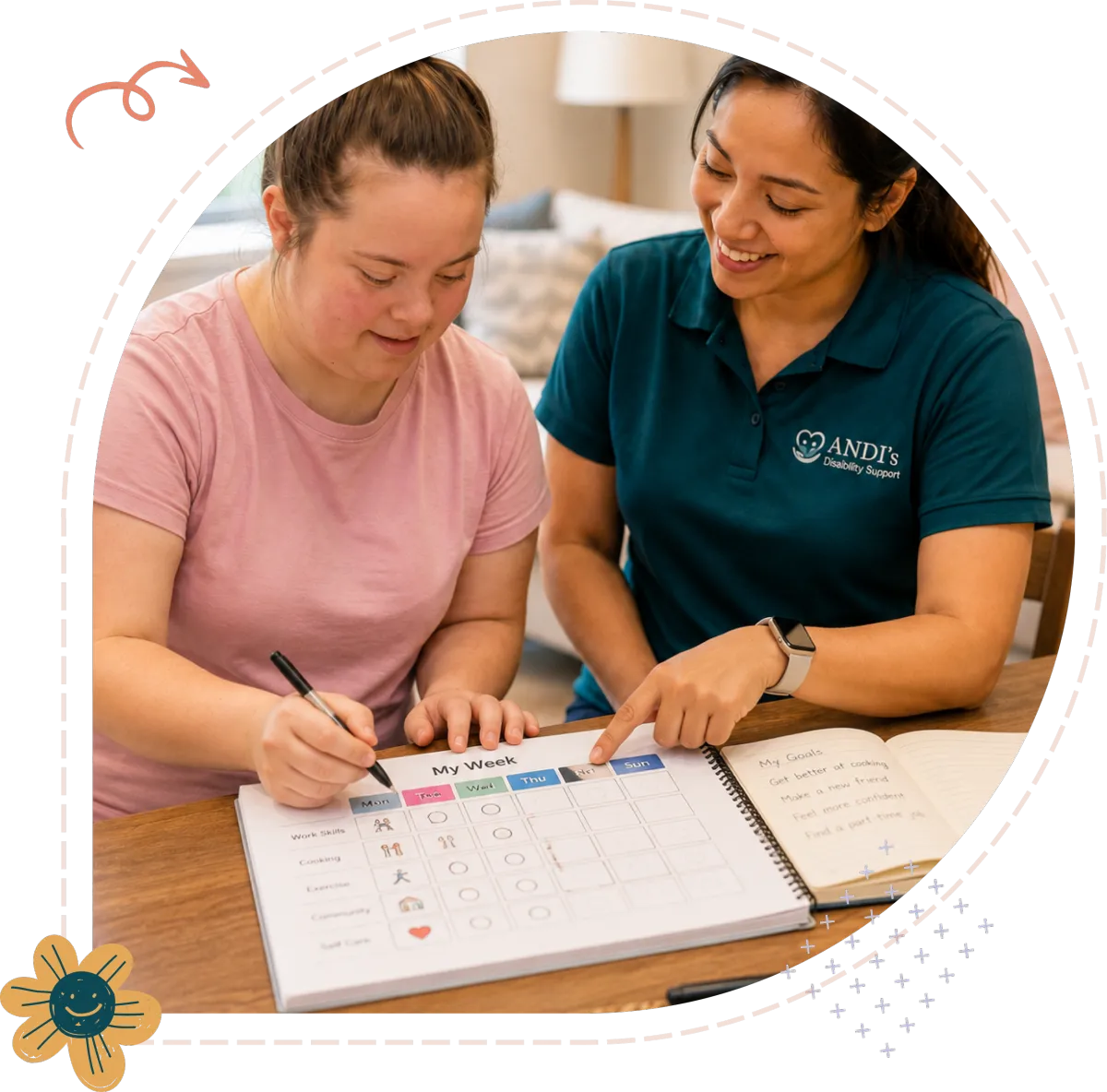
Tell us about your concerns, goals and what you're hoping to achieve.
We take the time to understand your situation and recommend the services that best support your individual.
Together, we develop a coordinated plan tailored to your strengths, goals and circumstances.
As your needs evolve, your support evolves too. Our team continues working alongside you to promote meaningful progress and long-term success.
Families under six have more funding options than most, and they are the ones people find hardest to navigate. Ask us before you start; sorting this out early is worth an afternoon.
We do not publish a single price, because what a family needs varies from a one-off consultation to a year of fortnightly coaching. You will get the fee for what you actually need, in writing, before anything is booked.
Nothing to apply for and nobody to wait on. Usually the fastest way to get a first look at what is happening.
The scheme has a separate pathway for young children with developmental concerns or disability, and it does not always require a diagnosis.
Rebates apply to eligible services with a GP referral and care plan, covering part of the fee for a limited number of sessions.
Depends on your level of cover and your remaining limit. Your fund can confirm the rebate before you book.
For children this young, the setting is not a convenience question. It largely decides whether what we practise ever gets used.
The default for this age group. Your toys, your kitchen, your bedtime, and a child who behaves like themselves instead of like a visitor.
Where your child spends the rest of the week. Educators can carry a strategy through every day, and they often notice things worth knowing.

Better for assessment, for specific equipment and for the sessions where fewer distractions genuinely help.
Surprisingly well suited to parent coaching, and often the difference between fortnightly contact and none during a sick week or a long drive.
Our team is happy to talk it through before you book anything.
No. We see babies, and quite a lot of what we do best is with children under two. At that age the work is mostly with you, and it is often short.
The more common problem is the opposite one: families who waited two years because they were told a child was too young, and arrived with a harder version of the same question.
Sometimes waiting is genuinely the right call, because the normal range is wide and many children do catch up without help. The problem is not the advice, it is the advice without a plan.
A reasonable "wait and see" has a checkpoint: what we are watching for, and when we look again. If you did not get that, a consultation will give you one. We are quite happy to tell you your child is developing normally.
Not to work with us, and often not for funding either — the early childhood pathway of the NDIS is built around developmental concern rather than a label, particularly for the youngest children.
Assessment is a separate decision. Some families want an answer, some want support first and questions later, and both are reasonable. We will tell you honestly what a diagnosis would and would not change at your child's age.
More than you might expect, and less than it sounds. The strategies are meant to fold into things you already do rather than add a homework hour to the end of the day. If we hand you something that needs an empty afternoon, tell us — we have got it wrong.
It also has to be honest about capacity. Families in the middle of illness, shift work, a new baby or their own health problems get a smaller plan, not a lecture.
Support does not stop at the school gate, but it does change shape. In the year before school we shift towards independence, attention, coping in a group and the practical business of the transition itself.
Some children finish with us before school starts. Others carry on with a smaller amount of support in the first year, and where you want it we will talk to the school so the classroom knows what already works.
Whether you're seeking support for yourself, your child or a loved one, we're here to listen, understand and help you move forward with confidence.
From assessment and therapy to counselling, disability support and home care, our team is committed to providing personalised care that empowers individuals and strengthens families.
We care deeply about the people we support, and it shows in how we work.

Qualified clinicians who supervise each other and keep learning.

Support that stays with you as your needs change, not just at the start.




We honour the diverse communities such as the LGBTQ of which we are a part and we celebrate the extraordinary diversity of people that each represent.

We acknowledge the traditional owners of the lands. We pay respect to Elders, past and present and acknowledge the ongoing connection that Aboriginal people have to this land and recognise Aboriginal people as the original custodians of this land.

Aboriginal peoples of the Kulin Nations are the Traditional Custodians of the lands now named City of Greater Dandenong. Those who live, work and contribute to the municipality walk in the footsteps of the Bunurong/Boon Wurrung and Wurundjeri Woi-wurrung Peoples, and are enriched by Australia’s First Peoples experiences, cultures, histories and knowledge.
© 2026 ANDI Support. All rights reserved.