Step 1
Start the Conversation
Tell us about your concerns, goals and what you're hoping to achieve.
An autism assessment answers a narrow question carefully: does this person's profile meet the diagnostic criteria for autism, and what would actually help them. Both halves matter, and the second one is the part people use.
You do not need to be certain before you enquire. Plenty of people ring us saying "probably not, but I keep wondering", and that is a reasonable place to start.

It is a structured, evidence-informed process for deciding whether someone's development and daily experience match the criteria for autism. It is not a test you pass or fail, and there is no blood test, brain scan or single questionnaire that settles it.
What it involves is gathering good information from several directions: direct assessment with the person, developmental history from those who have known them longest, standardised tools, and reports from the places they spend their time. Those pieces are then set against the current diagnostic criteria by clinicians who do this regularly.
A diagnosis is a description, not a verdict. It explains a pattern that was already there, gives it a name other people recognise, and opens doors to support and adjustments. It does not change who the person is, and it should not be the only thing you leave with.
Sometimes the answer is no. That is a real result rather than a wasted one: the profile of strengths and difficulties still explains what is hard, and the recommendations still apply.
The things families, teachers and adults themselves most often describe when they first ring. None of these is a test, and every one of them occurs in people who are not autistic.

How language is used and understood, which is different from how much language there is. Plenty of autistic people are highly articulate.
Commonly described
Speech arriving late, or arriving and then changing
Taking things literally, or finding hints hard to read
Talking at length about a subject of deep interest
Finding small talk effortful, pointless or exhausting
Not a lack of interest in people. More often a mismatch between how someone connects and how others expect them to.
Commonly described
Friendships that are intense, or hard to start and keep
Preferring to play or work alongside rather than with
Eye contact that feels uncomfortable or has to be remembered
Being described as blunt, aloof or too much
A strong preference for the predictable, and real distress when it is taken away without warning.
Commonly described
Distress at unexpected changes to plans
Doing things in a set order, or a set way
Repetitive movements that help with regulation
Difficulty moving from one activity to the next
Often the part that affects daily life most, and the part least often asked about before an assessment.
Commonly described
Noise, light, crowds or smells being genuinely painful
Clothing labels, seams and textures being unbearable
A very narrow range of foods
Seeking movement, pressure or particular textures
Deep, sustained interest in a subject. A strength as often as a difficulty, and frequently the thing a career is later built on.
Commonly described
Knowing a subject in extraordinary depth
Interests that others find unusual or unusually intense
Difficulty stopping, or being interrupted
Using the interest to recover from a hard day
Many people reach adulthood undiagnosed, particularly women, girls and anyone who learned early to hide the difficulty.
Commonly described
Copying other people's social behaviour deliberately
Coping all day, then collapsing at home
Long-running anxiety, burnout or a sense of being different
Recognising it after a child or sibling is diagnosed

Speech, play, motor skills and the routines that make kinder and childcare easier.

Communication, learning, sensory processing and the practical skills school asks for.

Counselling, emotional support, and the transitions that come thick and fast.

Life skills, confidence, and preparing for work, study or moving out.

Assessment, therapy, counselling and disability support, built around goals you set.
Home care, therapy and practical help, so staying put stays realistic.
Autism cannot be assessed from one appointment or one questionnaire, and anywhere offering that is cutting a corner that matters.

Information from several directions, because autism shows differently depending on who is watching, where, and how demanding the setting is.
Developmental history, from the people who have known the person longest.
Direct assessment with the person, using structured, autism-specific tools chosen for their age and communication.
Reports from another setting, usually kinder, school or a workplace, so we are not relying on one observer.
The person's own account, which for teenagers and adults is central rather than supplementary.

Not by adding up scores. The clinicians involved weigh the whole picture against the current diagnostic criteria and have to agree on what it shows.
More than one clinician contributes, which is what best practice in Australia expects for an autism diagnosis.
Other explanations are considered, including language difficulty, ADHD, anxiety, trauma and hearing, which can look similar and often coexist.
Support needs are described, not just the label, because that is the part schools and funders act on.
Uncertainty is stated honestly where it exists, rather than rounded up into a diagnosis or down into nothing.
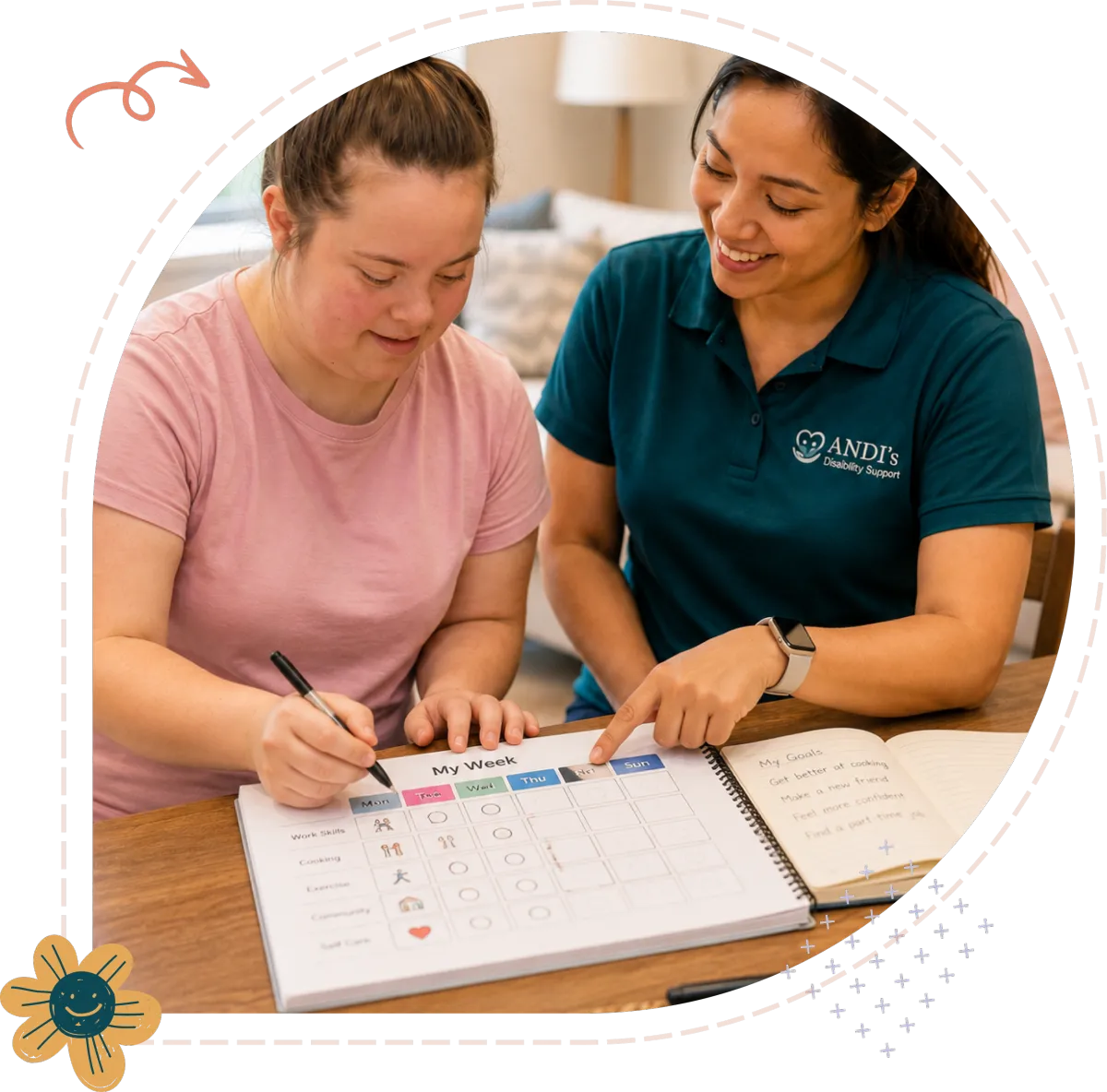
Tell us about your concerns, goals and what you're hoping to achieve.
We take the time to understand your situation and recommend the services that best support your individual.
Together, we develop a coordinated plan tailored to your strengths, goals and circumstances.
As your needs evolve, your support evolves too. Our team continues working alongside you to promote meaningful progress and long-term success.
Autism assessment is the single thing people most often pay for privately, and the cost is the reason many put it off. It is worth being straight about it before you book.
We do not publish a single figure, because the number varies with age, complexity and how many clinicians are involved, and a wrong number is worse than none. What we will do is quote you the whole cost in writing before you commit, including the report, rather than quoting a session rate and adding to it later.
No referral and no eligibility decision to wait on, and usually the shortest wait. The full cost is quoted before the first appointment.
Generally not funded purely to obtain a diagnosis for access, though assessment is funded in some existing plans. We will check with you rather than assume.
Rebates are available for some assessment appointments with a GP or paediatrician referral and a care plan. A rebate covers part of the cost, not all of it.
Depends on your level of cover and your remaining limit, and often applies to only part of the assessment. Your fund can confirm before you book.
Autism rarely arrives on its own, and sometimes it is not the right question at all. If what you are describing sounds more like one of these, say so and we will steer you.
Attention, activity, impulsivity and executive functioning, with information from home and from school or work.
A standardised measure of cognitive ability across four areas of reasoning, memory and speed.

A broader profile of attention, memory, processing speed, language and problem solving.
Our team is happy to talk it through before you book anything.
It varies with age and complexity, so we will not publish a number we cannot hold to. What we will do is give you the number of appointments and a realistic timeframe for the report, in writing, before you commit to anything.
As a general shape: an intake conversation, questionnaires out to school or work, more than one assessment session, a feedback session, then the written report.
No. You can contact us directly and book. A referral matters for funding rather than for access: Medicare rebates need a GP or paediatrician referral and a care plan.
You also do not need anyone else to agree with you first. Plenty of people are told by a GP or a teacher that a child seems fine and turn out to be right to keep asking.
Yes, and yes. Adult assessment is a growing part of what we do, particularly for women and for anyone who learned early to mask the difficulty and coped until the demands outgrew the strategies.
The process differs: we rely more on history, self-report and adult-specific tools, and less on live observation of development. That is a different method, not a lesser one, and the resulting diagnosis carries the same weight.
It is often part of what those processes ask for, but nobody can promise the outcome. Access decisions are made by the NDIS or by the school and department, not by us.
What we control is the quality of the evidence. Our reports describe functional impact in concrete terms, which is what those processes actually assess. Tell us at intake what the report is for, and we will make sure it covers what that process asks for.
That is a real and useful result. Ruling something out narrows the field, and the assessment still produces a detailed profile of strengths and difficulties that explains what is hard.
Very often the process points somewhere else: ADHD, a language difficulty, anxiety, a learning difficulty, or a combination. You get recommendations either way, and if the next step is another assessment or a course of therapy we will tell you plainly.
Whether you're seeking support for yourself, your child or a loved one, we're here to listen, understand and help you move forward with confidence.
From assessment and therapy to counselling, disability support and home care, our team is committed to providing personalised care that empowers individuals and strengthens families.
We care deeply about the people we support, and it shows in how we work.

Qualified clinicians who supervise each other and keep learning.

Support that stays with you as your needs change, not just at the start.



We honour the diverse communities such as the LGBTQ of which we are a part and we celebrate the extraordinary diversity of people that each represent.

We acknowledge the traditional owners of the lands. We pay respect to Elders, past and present and acknowledge the ongoing connection that Aboriginal people have to this land and recognise Aboriginal people as the original custodians of this land.

Aboriginal peoples of the Kulin Nations are the Traditional Custodians of the lands now named City of Greater Dandenong. Those who live, work and contribute to the municipality walk in the footsteps of the Bunurong/Boon Wurrung and Wurundjeri Woi-wurrung Peoples, and are enriched by Australia’s First Peoples experiences, cultures, histories and knowledge.
© 2026 ANDI Support. All rights reserved.