Step 1
Start the Conversation
Tell us about your concerns, goals and what you're hoping to achieve.
A psychoeducational assessment sets cognitive ability against actual achievement in reading, writing and maths. It is the assessment that answers the question most families arrive with: why is this one thing so hard when everything else is fine?
If the school has asked for "testing" and you are not sure what they mean, forward us what they sent. Half the time it names the assessment, and it saves you paying for the wrong one.
A child who cannot read at the end of Year 2 might have a specific learning disorder. They might also have missed a year of phonics, be sitting too far from the board, be exhausted by holding still, or be learning in their second language. All of those look identical from the kitchen table.
Testing achievement on its own does not separate them. Testing ability on its own does not either. What separates them is the two measured together, alongside what the school has already tried and what happened when they tried it.
That is the whole design of this assessment. We measure reasoning, memory and processing speed; we measure reading, writing and maths against the same age norms; we look at the processes underneath, such as phonological awareness and how quickly a child can name things they know. Then we compare all of it with what the classroom actually reports.
Sometimes the answer is a diagnosis. Sometimes the answer is that the profile is intact and the teaching needs to change. Both are useful, and we will tell you which one you have.

Five areas measured directly, plus the classroom evidence that makes sense of them. Not every child needs all five, and we will say so before you pay for them.

The reasoning, memory and speed side of it. This is the benchmark that achievement gets compared against.
IIncludes
Verbal, visual and fluid reasoning
Working memory and processing speed
The profile, not only the overall score
Reported with confidence ranges
Reading is several skills that can fail independently, so we test them separately rather than as one thing.
Measured as
Decoding real and made-up words
Reading rate and fluency aloud
Comprehension of what was read
Spelling, which usually lags longest
The most common complaint from secondary teachers, and the one most often mistaken for not trying.
Measured as
Handwriting or typing speed under time
Spelling and punctuation in real writing
Sentence and paragraph structure
The gap between spoken and written ideas
Maths difficulty is under-identified because it is easier to hide than reading difficulty.
Measured as
Number sense and estimation
Calculation accuracy
Fluency with facts that should be automatic
Word problems, where reading and maths meet
The skills that literacy and numeracy are built on. When these are weak, practice alone tends not to fix the problem.
Often includes
Phonological awareness, the sounds inside words
Rapid naming of familiar things
Verbal memory and word retrieval
Attention and organisation during work
A diagnosis of a learning disorder depends on difficulty that has persisted despite good teaching, and only the school can evidence that half.
We ask for
Reports, work samples and NAPLAN if you have them
What support has already been tried, and for how long
What changed, or did not, when it was tried
A teacher questionnaire, with your consent

Speech, play, motor skills and the routines that make kinder and childcare easier.

Communication, learning, sensory processing and the practical skills school asks for.

Counselling, emotional support, and the transitions that come thick and fast.

Life skills, confidence, and preparing for work, study or moving out.

Assessment, therapy, counselling and disability support, built around goals you set.

Home care, therapy and practical help, so staying put stays realistic.
The testing is standardised, which makes it comparable. The interpretation depends on history, and that is where the limits sit.

One-to-one with a clinician, usually split across two appointments so that fatigue does not become part of the result.
Ability first, achievement second, normally on separate days, with breaks whenever they are needed.
Everyone reaches items they cannot do. That is how the tests find a ceiling, and we explain it beforehand so it does not feel like failure.
Glasses, hearing aids and any usual supports come along, because we want the everyday version of the person, not a stripped-back one.
No practice and no preparation. Coaching does not raise ability, it just makes the result wrong.

The honest limits, which we would rather set out here than have you discover them after paying.
A diagnosis needs persistence over time. Difficulty that has not yet been given targeted teaching cannot be called a learning disorder, however low the scores.
Interrupted schooling and English as an additional language can produce the same scores for entirely different reasons, and we interpret with that in view.
Vision and hearing get ruled out first. They are the cheapest explanations available and they are checked before anything else is concluded.
It does not diagnose ADHD or autism, though it frequently shows why one of those should be looked at next.
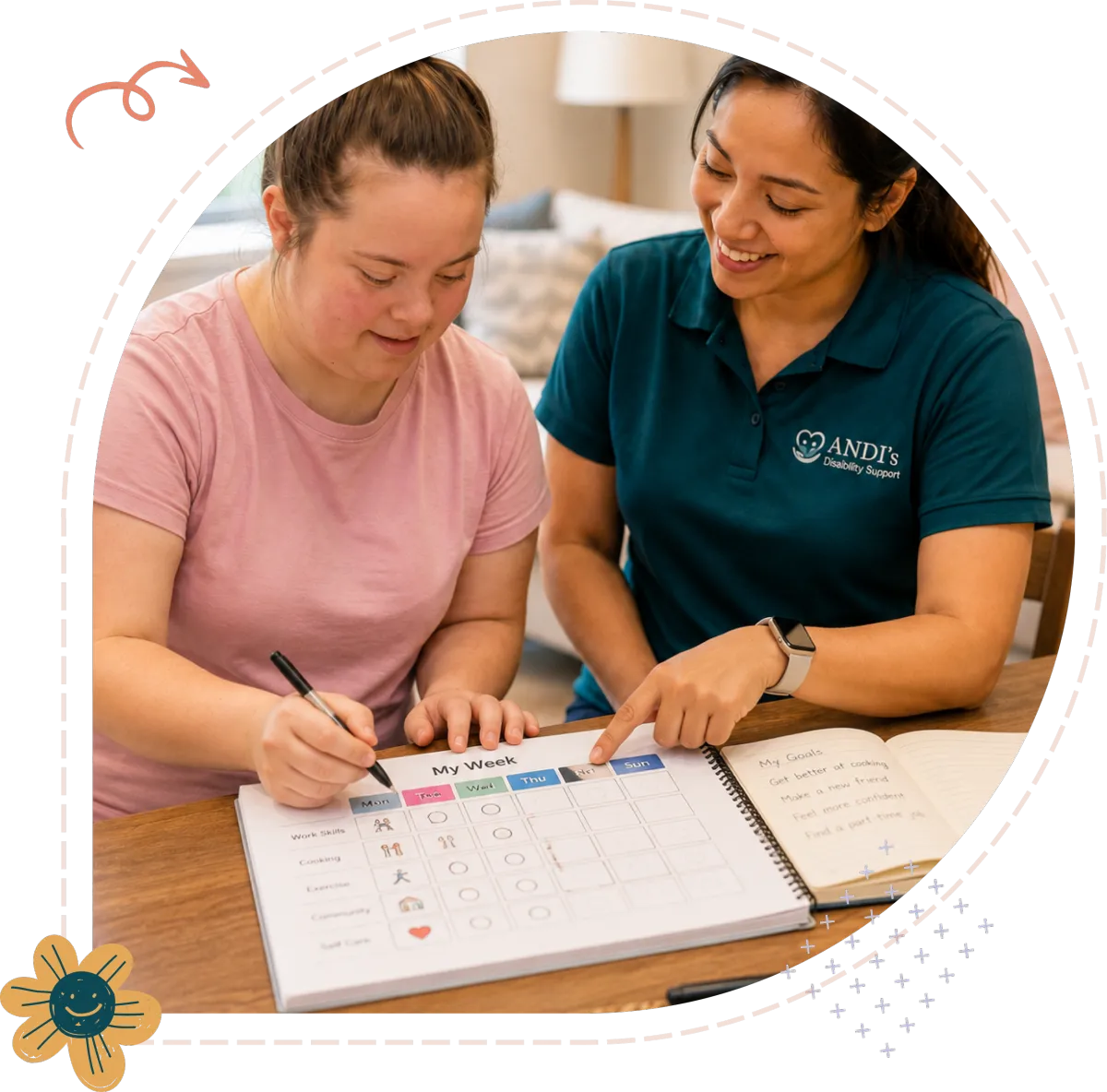
Tell us about your concerns, goals and what you're hoping to achieve.
We take the time to understand your situation and recommend the services that best support your individual.
Together, we develop a coordinated plan tailored to your strengths, goals and circumstances.
As your needs evolve, your support evolves too. Our team continues working alongside you to promote meaningful progress and long-term success.
A psychoeducational assessment covers more ground than an IQ assessment and usually costs more. It is also the assessment least likely to be funded by anyone other than you, which we would rather say here than at the invoice.
We quote the whole cost in writing before you commit, including the report and the feedback session. If a narrower assessment would answer your question, we will say so at the enquiry stage.
The usual pathway. No referral and no eligibility decision, with the full cost quoted in writing before the first appointment.
A specific learning disorder on its own is not usually a basis for NDIS access, and plans rarely fund educational assessment. We will check with you.
Assessment for educational purposes is generally not rebatable. Where testing forms part of an eligible mental health assessment, a GP referral may apply.
Depends on your level of cover and your remaining limit. Your fund can confirm the rebate before you book.
Learning difficulty and attention, autism or ability sit close together, and they are frequently confused. If your question is really one of these, it is better to find that out now.
Attention, activity, impulsivity and executive functioning, with information from home and from school or work.
Ability assessed alongside adaptive functioning, where difficulty runs across every area of life rather than one subject.

Cognitive ability on its own, where a process asks specifically for a standardised ability measure and nothing more.
Our team is happy to talk it through before you book anything.
It is the assessment that identifies dyslexia, yes. There is no separate dyslexia test. Dyslexia is a specific learning disorder in reading, and it is identified by measuring reading and spelling against ability and against age, looking at the processes underneath such as phonological awareness, and confirming the difficulty has persisted despite good teaching.
The same assessment identifies difficulties in written expression and in maths, which often travel with reading difficulty and are missed when people ask only about dyslexia.
Australian schools have obligations under the disability standards for education to make reasonable adjustments for a student with disability, and a report is the evidence those decisions get made from. What it does not do is dictate a particular adjustment or unlock a particular pot of money.
We write recommendations that name the change rather than the principle, so the conversation with the school starts somewhere concrete. If it would help, we can join a school meeting to talk through the findings.
No. Cognitive ability testing is part of a psychoeducational assessment, so you are not buying it twice. If you already have a recent IQ assessment, send it to us; depending on which test was used and how long ago, we can often build on it rather than repeat it.
Repeating the same cognitive test too soon inflates the result because of familiarity with the tasks, so there is a real reason not to duplicate.
Achievement testing needs enough schooling to measure, so the useful window generally opens near the end of the first year of school. Before that, the more helpful step is targeted teaching and a look at language and early literacy skills, and we will say so rather than test too early.
Adults can and do have one, usually for university, TAFE or workplace adjustments, or because school was a struggle and nobody ever worked out why. The tests differ; the logic is the same.
No, and the difference matters. A specific learning disorder affects a particular area, most often reading, writing or maths, while overall ability sits in the typical range. An intellectual disability involves both ability and everyday adaptive skills across the whole of life, and it is assessed differently.
Part of what this assessment does is tell you which of the two you are looking at, and it is not unusual for the answer to be neither.
Whether you're seeking support for yourself, your child or a loved one, we're here to listen, understand and help you move forward with confidence.
From assessment and therapy to counselling, disability support and home care, our team is committed to providing personalised care that empowers individuals and strengthens families.
We care deeply about the people we support, and it shows in how we work.

Qualified clinicians who supervise each other and keep learning.

Support that stays with you as your needs change, not just at the start.



We honour the diverse communities such as the LGBTQ of which we are a part and we celebrate the extraordinary diversity of people that each represent.

We acknowledge the traditional owners of the lands. We pay respect to Elders, past and present and acknowledge the ongoing connection that Aboriginal people have to this land and recognise Aboriginal people as the original custodians of this land.

Aboriginal peoples of the Kulin Nations are the Traditional Custodians of the lands now named City of Greater Dandenong. Those who live, work and contribute to the municipality walk in the footsteps of the Bunurong/Boon Wurrung and Wurundjeri Woi-wurrung Peoples, and are enriched by Australia’s First Peoples experiences, cultures, histories and knowledge.
© 2026 ANDI Support. All rights reserved.