Step 1
Start the Conversation
Tell us about your concerns, goals and what you're hoping to achieve.

Good support work is measured by what someone can do a year later, not by how many hours were billed. The point is a bigger life — your own home, your own routines, your own decisions — with help sized to what you actually need.
You do not need to arrive with everything worked out. If you have a plan we will work to the goals already in it, and if you do not, we can help you think through what support would actually look like.

It sits between the two, and it is the part of the system people understand least when they start. A support worker is someone who is there while the day happens, doing the parts you need help with and standing back for the parts you do not.
That distinction decides everything about how the shift goes. A worker who does everything makes the visit smooth and the year worse. A worker who does nothing is not support. The skill is knowing, for this person on this day, which of those the moment calls for — and being honest when the answer changes.
Because ANDI is multidisciplinary, our support workers are not operating on their own judgement alone. Where a person also sees an occupational therapist, a speech pathologist or a counsellor here, the worker is briefed on the plan: the way a transfer is meant to be done, the communication system in use, the strategy that was agreed for the hard part of the afternoon.
It also runs the other way. Support workers are with people for hours at a time and notice things a clinician in a fortnightly appointment never will. With consent, that goes back into the plan rather than staying in the car.
Six areas. Most people use two or three, and what they use changes over the years — which is the point of reviewing it rather than setting it once.

The structure of an ordinary day, held together where it needs holding. Often the support that makes everything else possible.
Often includes
Morning and evening routines
Meal preparation, shopping and the weekly food question
Keeping the house liveable
Prompts and reminders, including for medication routines
The most intimate support there is, and the one where how it is done matters as much as whether it is done.
Often includes
Showering, dressing and grooming
Toileting and continence support
Transfers and mobility around the house
Support done your way, in your order, at your pace
Getting out of the house for reasons that are yours. Not an activity roster designed by somebody else.
Often includes
Sport, classes, groups, gigs and places you already like
Support at appointments, including help to be heard in them
Volunteering, study and work experience
Mentoring for young people, with a worker they choose
Teaching, not doing. This is the area where support should be visibly working itself out of a job.
Often includes
Cooking, laundry and running a household
Money, bills and keeping track of appointments
Phone calls, forms and dealing with organisations
Getting ready to move out, and the first year of doing it
Independence usually stalls at the same place: how you get there. Travel training is one of the highest-value supports there is.
Often includes
Learning a route on public transport, then doing it alone
Transport to appointments, work and study
Planning trips, reading timetables and handling changes
What to do when something goes wrong on the way
For the weeks that are not like the other weeks. Support that scales up for a while and then goes back down.
Often includes
Extra support after a hospital stay or a change in health
Respite so a family carer can rest, work or go away
School holidays, and the gaps in other services
Cover while a usual arrangement is being sorted out

Speech, play, motor skills and the routines that make kinder and childcare easier.

Communication, learning, sensory processing and the practical skills school asks for.

Counselling, emotional support, and the transitions that come thick and fast.

Life skills, confidence, and preparing for work, study or moving out.

Assessment, therapy, counselling and disability support, built around goals you set.

Home care, therapy and practical help, so staying put stays realistic.
Two things decide whether support works: who turns up, and whether they know what they are doing there.

The single biggest predictor of whether support works is the relationship. A perfectly qualified worker who does not get on with you is the wrong worker, and no amount of scheduling software fixes that.
We ask what you want in a worker — gender, language, age, interests, temperament — and treat the answers as requirements, not preferences.
You meet them before it starts, and you can say no. That is not awkward; it is the process working.
Consistency wherever we can manage it, because explaining yourself to a new person every fortnight is its own kind of work.
Screened and checked, including NDIS Worker Screening and Working with Children Checks where they apply, plus training relevant to your support.

Plenty of support is delivered by people handed an address and a start time. Where therapy and support sit in the same organisation, there is no excuse for that.
Goals in your words, written down, so everyone is working towards the same thing rather than towards "assistance".
Clinical strategies handed over properly — communication systems, transfers, regulation plans — instead of being reinvented on each shift.
What the worker does not do, written down as clearly as what they do. Boundaries protect everybody, including you.
Reviewed on a schedule, because support that is never reviewed drifts into doing too much.
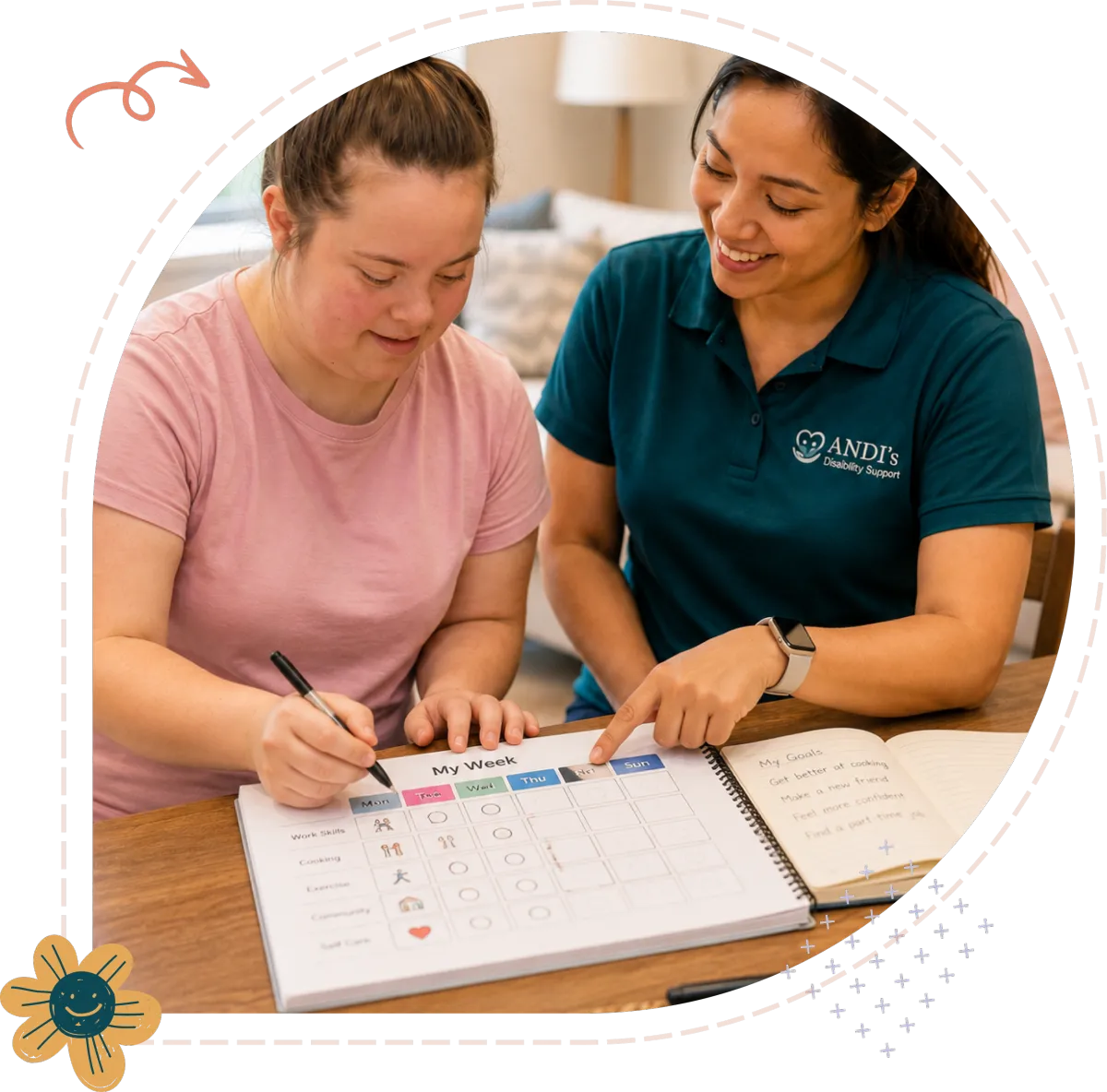
Tell us about your concerns, goals and what you're hoping to achieve.
We take the time to understand your situation and recommend the services that best support your individual.
Together, we develop a coordinated plan tailored to your strengths, goals and circumstances.
As your needs evolve, your support evolves too. Our team continues working alongside you to promote meaningful progress and long-term success.
For most people this is NDIS-funded, and it is the one service on our site where that is usually true. It is still not automatic: a disability does not by itself mean a plan, and a plan does not automatically include support work.
People also purchase support privately, and people over 65 usually reach it through the aged care system instead. If you are not sure which of those describes you, that is a five minute conversation and worth having before anything else.
No eligibility test and no plan required. Often used for a small number of hours, or while an NDIS application is in progress.
Where support work is funded in your plan, we can deliver it. What you can spend, and on what, is set by your plan rather than by us.
Self-managed and plan-managed participants can choose any provider. Agency-managed plans can only be spent with registered providers — ask us and we will tell you plainly where we stand.
People who first need support after 65 generally go through the aged care system rather than the NDIS. Existing participants can usually stay.
Four commitments. They are easy to write and harder to hold to on a busy Thursday, which is why they are here in public.
Doing something for someone is faster every single time. We would rather the slower version, unless you have told us otherwise for good reason.
How you like your kitchen, whether the radio is on, who gets told what. Support happens in your space and on your terms.

About the worker, the hours, the tasks or the whole arrangement. Changing your mind is not ingratitude, it is how you stay in charge of it.
Privacy, consent for each step, and no discussion of your body with anyone who does not need to know. This one is not negotiable.
Our team is happy to talk it through before you book anything.
No. Plenty of people buy a few hours privately, and some use support while an NDIS application is still in progress. A plan changes who pays, not whether support is available.
If you think you may be eligible and have not applied, say so when you contact us. It is worth getting the sequence right, because some evidence is easier to gather before support starts than after.
Tell us, and we will change it. You do not have to justify it, soften it, or wait until something goes wrong. "It is not working" is a complete reason.
We would much rather hear it in week two than find out in month six that someone has been putting up with a bad fit. Nothing about raising it will affect the rest of your service.
There are firm limits here and they exist for good reasons. Support workers can prompt and assist with medication routines within their training and the agreed plan. Tasks that require a nurse or a clinician are not support work, and a worker who offers to do them anyway is a warning sign rather than a favour.
Where a support need is genuinely clinical, we will say so and help you find the right person. What we can do is make sure the worker knows the plan written by whichever clinician is responsible.
On a given day the two can look almost identical — someone helping with a shower, a meal or a trip out. The difference is the system funding it and, usually, the direction of travel.
Disability support is generally about building and holding independence over a lifetime. Home care is generally about staying safe and comfortable at home as things change with age. Age 65 is the usual dividing line between the two funding systems, and our home care page covers that side.
Yes, and we would usually recommend it. A couple of hours a week aimed at one specific thing tells you more about whether support suits you than a large package arranged in advance.
Hours are easy to increase once you know what is working. Unwinding a big arrangement that was set up on a guess is much harder, and it tends to leave people with support they did not want and no room for the support they did.
Whether you're seeking support for yourself, your child or a loved one, we're here to listen, understand and help you move forward with confidence.
From assessment and therapy to counselling, disability support and home care, our team is committed to providing personalised care that empowers individuals and strengthens families.
We care deeply about the people we support, and it shows in how we work.

Qualified clinicians who supervise each other and keep learning.

Support that stays with you as your needs change, not just at the start.




We honour the diverse communities such as the LGBTQ of which we are a part and we celebrate the extraordinary diversity of people that each represent.

We acknowledge the traditional owners of the lands. We pay respect to Elders, past and present and acknowledge the ongoing connection that Aboriginal people have to this land and recognise Aboriginal people as the original custodians of this land.

Aboriginal peoples of the Kulin Nations are the Traditional Custodians of the lands now named City of Greater Dandenong. Those who live, work and contribute to the municipality walk in the footsteps of the Bunurong/Boon Wurrung and Wurundjeri Woi-wurrung Peoples, and are enriched by Australia’s First Peoples experiences, cultures, histories and knowledge.
© 2026 ANDI Support. All rights reserved.