Step 1
Start the Conversation
Tell us about your concerns, goals and what you're hoping to achieve.

Being ready for school has very little to do with letters and numbers. It is being able to leave you at the gate, ask an adult for help, sit through a story, open a lunchbox and still have something left at half past three.
If kinder has raised something, or you are weighing up whether to send your child or wait another year, that is worth talking through with someone who does not have a place to fill.

The phrase "school ready" makes it sound like a level a child either reaches or does not. It is better understood as a fit between a particular child and a particular classroom, and both sides of that can be adjusted.
That matters, because a great deal of the anxiety around this is aimed at the wrong thing. Parents buy alphabet workbooks. What actually predicts a decent first year is duller and more human: managing feelings, following a group instruction, having a go at something hard, and telling an adult when you need help.
So we work on two fronts. We build the skills that make a school day survivable, and we make sure the school starts the year knowing what your child needs rather than discovering it in week six. Both are ordinary work, and the second one is often the part that changes the term.
We are also honest about the limits. No program guarantees a smooth start, some children need the first term to settle no matter what anyone does beforehand, and plenty of children need nothing from us at all. We will tell you if yours is one of them.
Teachers will tell you the same thing: the children who cope are not the ones who arrive reading. They are the ones who can manage themselves in a room of twenty-five.

Being understood by an adult who does not know your child, and understanding instructions given to the whole room rather than to them.
Often includes
Speech clear enough for a new teacher
Following two-part and group instructions
Asking for help, and saying when something is wrong
Telling you about the day once they are home
Mat time is a genuine skill: filtering out twenty-four other children, holding an instruction and starting without a personal prompt.
Often includes
Sitting and listening in a group for a realistic stretch
Knowing that "everyone" includes you
Staying with a task long enough to finish it
Coping with noise, movement and a busy room
The part that decides whether school feels safe. Separating at the gate, recovering from a setback, and finding somebody to be with at lunch.
Often includes
Separating at drop-off without it wrecking the morning
Coping with losing, waiting and not being chosen
Joining in, sharing and sorting out small conflicts
What to do in the yard when you have nobody to play with
Small practical things that quietly ruin a day when they go wrong, and that nobody has time to help with in a class of twenty-five.
Often includes
Toileting independently, and asking to go
Lunchboxes, drink bottles and eating in the time available
Shoes, jumpers, hats and hooks
Keeping track of their own belongings
Fine motor skill is not about neat handwriting at five. It is about being able to join in with the table activity without it hurting.
Often includes
Pencil grip, drawing and early writing
Scissors, glue, threading and construction
Hand strength and endurance for a whole activity
Sitting comfortably at a table for as long as the task takes
Last on the list on purpose. Useful, but far less predictive of a good first year than any of the five above.
Often includes
Hearing rhyme and the sounds inside words
Knowing that print carries meaning, and enjoying books
Recognising their own name
Counting, comparing and simple patterns

Speech, play, motor skills and the routines that make kinder and childcare easier.

Communication, learning, sensory processing and the practical skills school asks for.

Counselling, emotional support, and the transitions that come thick and fast.

Life skills, confidence, and preparing for work, study or moving out.

Assessment, therapy, counselling and disability support, built around goals you set.

Home care, therapy and practical help, so staying put stays realistic.
Half the work is with your child. The other half is making sure the adults at the school know what they are dealing with before the first bell.

Readiness worries are often vague, and vague worries produce vague programs. The first job is turning "I don't think she's ready" into two or three specific things we can do something about.
A conversation with you, and with kinder where you want us to talk to them. Their view and yours are often different and both are true.
Watching your child in a group, not only across a table. Mat time tells us more than any checklist.
Assessment where a question needs answering — speech, motor skills, attention, learning — and not where it does not.
A short list of priorities, because a child cannot work on nine things and neither can a family in October.

Every school runs a transition process. Most of them are built for the average child and rely on a form. Where more than that is needed, this is where a therapy team earns its fee.
A one-page handover in plain language: what works, what does not, and what to do when it goes wrong. Teachers read one page.
Input to the school's transition meeting, with your consent, including joining it where that is useful.
Practical adjustments to ask for, named specifically enough that a school can actually say yes or no to them.
A check-in a few weeks into term one, when the real picture finally appears and the plan usually needs one adjustment.
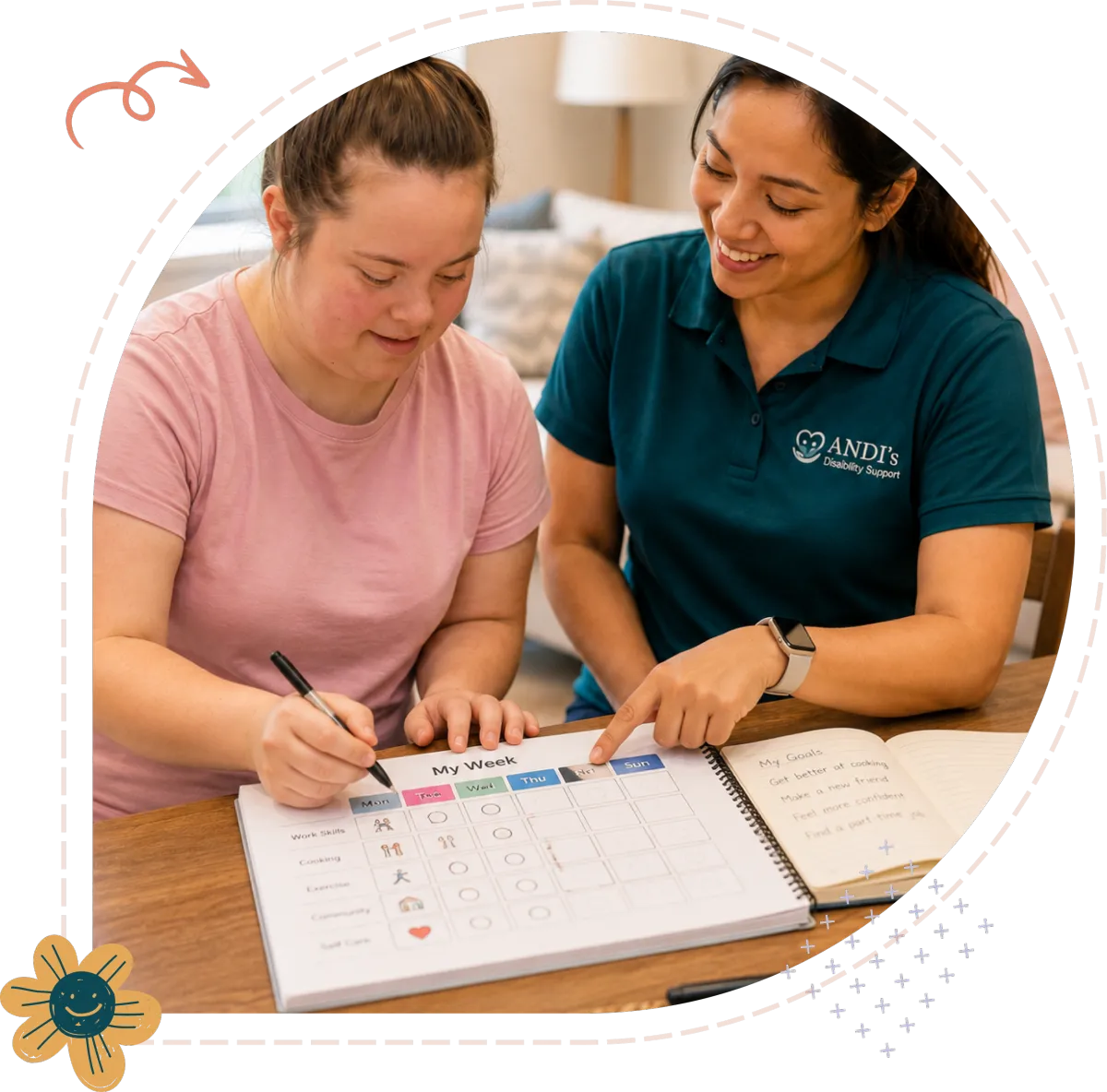
Tell us about your concerns, goals and what you're hoping to achieve.
We take the time to understand your situation and recommend the services that best support your individual.
Together, we develop a coordinated plan tailored to your strengths, goals and circumstances.
As your needs evolve, your support evolves too. Our team continues working alongside you to promote meaningful progress and long-term success.
This is the page where we have to be most careful, because school readiness is not a funded category in its own right. What gets funded is the underlying service — speech pathology, occupational therapy, assessment — and only where the person is eligible for that pathway.
In practice most school readiness work is paid for privately, and it is usually a short block rather than a long commitment. Where a child has a plan or a care plan, the same sessions may be claimable. Ask us and we will tell you which of those you are in.
How most families do this. Nothing to apply for, and the whole thing is often a short block quoted in advance.
Only where a child has a plan and the work relates to their disability-related goals. Starting school is not by itself a reason for a plan.
Rebates apply to eligible allied health services with a GP referral and care plan. Not every school readiness appointment qualifies.
Speech pathology and occupational therapy are commonly covered. Your fund can confirm the rebate and your remaining limit.
Earlier is easier, but nothing here is a deadline. Families come to us at every one of these points and all four are workable.
The most comfortable place to start. Time for therapy to work, time for a school decision, and no rush about any of it.
The point where the question stops being theoretical. Good timing for assessment if a decision or an application depends on one.

Focused work on the practical skills, plus the handover to the school. Short, targeted and worth doing even if you start here.
A hard first term is information, not a verdict. Acting in weeks rather than terms usually stops a rough start from setting into a story about themselves.
Our team is happy to talk it through before you book anything.
No. Teaching reading is the school's job, and prep teachers expect to start from the beginning. What helps is the groundwork underneath it: hearing rhyme and sounds, enjoying books, knowing print means something, and recognising their own name.
A child who arrives reading and cannot cope when a game goes against them will have a harder term than one who arrives with neither letters nor drama.
There is no evidence-backed rule that fits every child. Research on delaying entry is mixed, the early advantage of being older often narrows over time, and an extra kinder year is only worth having if it is a good one.
What we can give you is a proper look at your child against what school will actually ask of them, an honest opinion, and the reasoning behind it. Then you decide. We will not tell you there is only one responsible answer, because there usually is not.
Both of you can be right. Some children hold it together all day at kinder and fall apart the moment they get in the car, which means educators genuinely are not seeing what you are seeing.
It also runs the other way: children who are settled at home and struggling in a group. That is why we look in more than one setting before forming a view, rather than taking either report as the whole picture.
For most families it is short — an assessment or observation, a handful of sessions on two or three specific things, a handover to the school and a check-in during first term.
It gets longer when there is something underneath it, such as a speech or language difficulty, motor difficulties or a disability. In that case the school readiness part is one piece of a bigger plan, and we will say so rather than repackaging ongoing therapy under this heading.
Yes, with your consent, and we think it is one of the more valuable things we do. That can be a written summary, a phone call to the prep teacher, or attending a transition meeting with you.
You control what is shared. Nothing goes to a school without your say-so, and we will show you the summary before it is sent.
Whether you're seeking support for yourself, your child or a loved one, we're here to listen, understand and help you move forward with confidence.
From assessment and therapy to counselling, disability support and home care, our team is committed to providing personalised care that empowers individuals and strengthens families.
We care deeply about the people we support, and it shows in how we work.

Qualified clinicians who supervise each other and keep learning.

Support that stays with you as your needs change, not just at the start.




We honour the diverse communities such as the LGBTQ of which we are a part and we celebrate the extraordinary diversity of people that each represent.

We acknowledge the traditional owners of the lands. We pay respect to Elders, past and present and acknowledge the ongoing connection that Aboriginal people have to this land and recognise Aboriginal people as the original custodians of this land.

Aboriginal peoples of the Kulin Nations are the Traditional Custodians of the lands now named City of Greater Dandenong. Those who live, work and contribute to the municipality walk in the footsteps of the Bunurong/Boon Wurrung and Wurundjeri Woi-wurrung Peoples, and are enriched by Australia’s First Peoples experiences, cultures, histories and knowledge.
© 2026 ANDI Support. All rights reserved.